

The Diamondbacks' Next Competitive Window Depends on Ryne Nelson
Ryne Nelson will need to deepen his arsenal to become the frontline starter the Diamondbacks need to become postseason contenders again.

The Arizona Diamondbacks are in a pickle with their starting rotation. Despite adding two starters to their rotation, it’s a unit that lacks certainty, depth, and upside. However, one pitcher has a chance to change the D-backs’ rotation outlook: right-hander Ryne Nelson.
The right-hander emerged in 2025, pitching to a 3.39 ERA over 154 innings. However, more advanced run prevention metrics paint Nelson as a slightly above-average starting pitcher.
FIP: 3.73 (94 FIP-)
xFIP: 4.05 (98 xFIP-)
xERA: 3.93 (52nd percentile)
To add proper context, Nelson’s FIP was 6% better than the league-average pitcher, and his xFIP 2% better. I use minus stats instead of plus stats for pitchers, because it gives better context and fits with the lower is better motif of run-prevention metrics. In my system, I’d project him as a No. 3 starter with room to grow if he can deepen or alter his established arsenal.
For the Diamondbacks to be a contender in 2026, they need Nelson to take the next step and develop into a frontline starter. Merrill Kelly is 37 years old, Eduardo Rodríguez is 33 with an injury history, and Brandon Pfaadt has a career ERA over 5.00. So it’s incumbent on the 29-year-old to become the type of starter Arizona envisioned when they drafted him 56th overall in 2019.
Here’s a breakdown of what the Diamondbacks could do to turn Nelson into a potential ace. He posted a 21.3% strikeout rate and a 6.6% walk rate. The walk rate is ideal, but his strikeout rate is mostly platoon-based. He’s punching out 23.4% of right-handed hitters vs. 18.9% of left-handed hitters. Getting more swing-and-miss vs. lefties is going to be the key to taking the next step.
Ryne Nelson Throws Too Many Fastballs
In order to improve his results, it starts by analyzing his repertoire and identifying the right fixes. The biggest takeaway is that he is fastball-dominant, with his four-seamer accounting for more than 60% of his pitches.
It makes sense for him to lead with that pitch, as it sits 95.7 MPH with 19.4” of induced vertical break and very little horizontal break (3.2” arm-side). Unlike other pitchers, Nelson doesn’t have to cut his fastball to get that vertical shape. His active spin rate on his four-seamer is 99%. That means he’s very good at imparting backspin on the ball, even if his spin rate is in the 45th percentile.
However, even with a 65-70 grade fastball, you can make an argument that 60% is too much. One such start where it came to a head was his outing against the Texas Rangers on August 11th. He was dominating for five innings, but became too reliant on his four-seamer, and the Rangers hitters adjusted. He recorded just one more out, and Arizona lost the game.
The reason there’s a problem comes down to two concepts outlined by Lance Brozdowski: pitch decay and pitch buyback. Pitch decay means throwing too many of the same pitch, especially to the same location, will decrease the value of that pitch the next time he throws it. Pitch buyback is the opposite; using a pitch at a different speed and location will increase the value of that next pitch.
With Nelson, the key will be about changing speeds. Too many fastballs decay the value of his fastball, and using his secondary stuff increases his fastball value. Nelson’s run value on his four-seamer was +23 in 2025, but it was +1.5 per 100 pitches. The idea is that at a lower usage (~50%), it will increase the value on a rate basis.
Improving Nelson’s Secondary Stuff
The biggest thing to understand is look at the pitch movement plot. These are Nelson’s movement profiles for his 2025 arsenal.
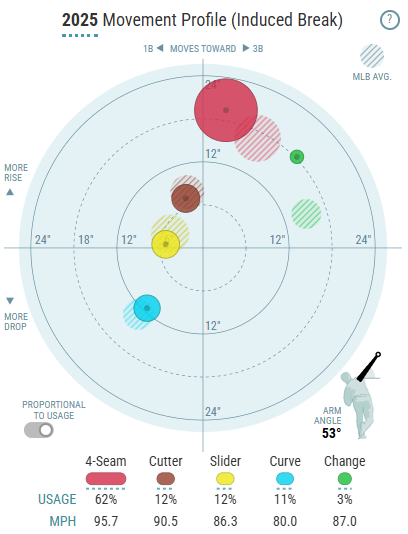
The biggest takeaway is that Nelson is mostly a north-south pitcher. However, it’s unclear how he should work off his four-seamer, especially with his breaking stuff. His four-seamer, cutter, slider, and curveball pretty much operate on the same line. That allows him to work hitters vertically, but not necessarily horizontally.
To find a pitch that can improve the value of his assortment of glove-side pitches, he’ll need an offering that works arm-side. His four-seamer doesn’t quite fit, given the mostly vertical profile.
That’s where the changeup comes into play. It would give him an arm-side offering that gives hitters a different look from his assortment of glove-side pitches. It would allow him to work east-west on hitters in addition to the north-south approach of his fastball, slider, and curveball.
The problem is the same characteristics that give Nelson a great four-seamer give him a terrible changeup. Like the four-seamer, Nelson gets a 99% spin efficiency on the pitch. At a 1:45 spin axis compared to 12:30 (four-seamer), that produces a movement profile of 12.7” iVB and 13.1” arm-side break. That just makes it an 87.0 MPH dead-zone fastball in terms of shape. To no one’s surprise, he’s yielding a .433 wOBA on 70 changeups thrown.
Nelson is going to have to find a way to kill the vertical carry to get the changeup out of the dead zone shape. But the question is what adjustment can be made without hurting his high-ride, high-efficiency four-seamer?
One such possibility is adjusting to a split-fingered fastball as his primary offspeed. That’s not a change Nelson can make overnight; it takes many months and bullpens to fine-tune a pitch to use against MLB hitters. An arsenal like this usually starts in catch-play exercises, then advances to bullpen sessions before it becomes game-ready.
Modeling a Potential Splitter for Ryne Nelson
Using the Active Spin leaderboard, I was looking for pitchers with at least a 50° arm angle with a 97% or higher active spin rate on four-seam fastballs and changeups. Four starters come up in addition to Nelson: Lucas Giolito, Austin Gomber, Tobias Myers, and Jonah Tong. Only Gomber and Myers have added a splitter in 2025, so those will be the two examples.
The two pitchers I’m comparing to Nelson couldn’t have two different splitter types.
Myers’ splitter has taken on a similar shape to his changeup. However, the change to a splitter grip turned a slow (81.1 MPH), dead-zone shape (12.5” iVB, 11.7” arm-side) in 2024 into a more workable offering. It now carries a velocity of 83.1 MPH with 10.5” iVB and 9.6” arm-side.
Gomber, on the other hand, developed a very funky splitter. The current shape is 3.0” iVB and 2.7” arm-side.
That might be a less ideal splitter shape for Nelson than the Myers example, but it seems like the more likely outcome. Gomber has similar spin efficiency numbers to Nelson on the slider (35.2% vs. 33.8%) and cutter (60.9% vs. 57.8%). It would not be a shock if the Diamondbacks right-hander developed a similar splitter.
It doesn’t offer as much east-west offering, given how close it is to his slider and cutter. But there’s enough separation from the four-seamer that it could be an effective offering at the bottom of the zone or below. More horizontal movement on a potential splitter would be more ideal, as it would open up backfoot sliders and hard cutters on the hands against left-handed hitters.
With Corbin Burnes out until after the All-Star break, Arizona needs either Ryne Nelson or Brandon Pfaadt to take the next step. If Nelson is unable to develop an offspeed pitch, that limits his ceiling to his current status as a mid-rotation starter. That’s a development that the team might not be able to afford, if the goal is for them to be a postseason contender again.